
What Is I-CBT for OCD? Inference-Based CBT Explained
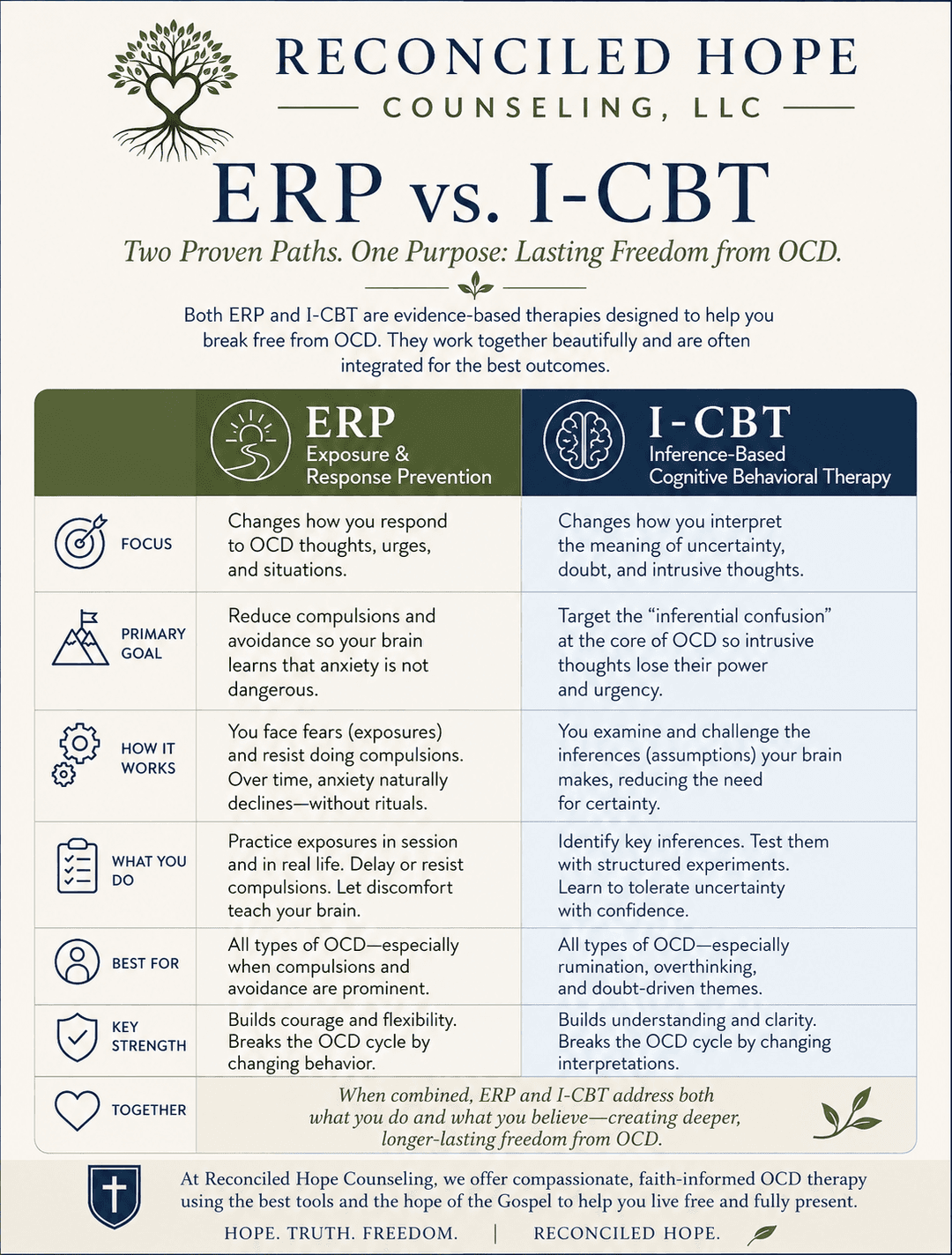
If you’ve heard that ERP is the gold-standard OCD treatment but felt like your particular obsessions don’t quite fit that model, you’re not imagining it. Some forms of OCD respond better to a different, complementary approach: Inference-Based CBT, or I-CBT.
The Problem I-CBT Targets
Most OCD treatment focuses on reducing the anxiety a trigger produces. I-CBT starts a step earlier — at the reasoning process that convinces you the obsessional doubt is worth taking seriously in the first place. It asks: why does your mind trust an imagined, hypothetical possibility over the evidence of your actual senses and experience?
How It Works
- We map out the specific reasoning story your OCD tells — often called the “obsessional narrative” — that leads from a normal trigger to a feared conclusion
- We identify where that reasoning departs from how you trust your judgment in every other area of life
- We rebuild trust in your direct senses and real-world evidence, rather than the hypothetical scenarios OCD constructs
- Over time, the obsessional doubt loses its grip because the reasoning underneath it no longer holds up
Who I-CBT Tends to Help Most
- “Pure O” presentations, where compulsions are mostly mental rather than visible
- Doubt-based obsessions (“What if I actually want this?” “What if I’m not who I think I am?”)
- Clients who’ve tried ERP and felt like something was still missing
- OCD themes where the feared scenario is abstract or hard to expose to directly
I-CBT and ERP Together
These approaches aren’t in competition — many clients benefit from a blend of both, tailored to how their particular OCD operates. Part of early treatment is figuring out which combination fits your specific presentation, rather than applying one protocol to every case.
Getting Started
I provide ERP and I-CBT for teens and adults with OCD in Chattanooga, TN, in person and via telehealth. Learn more on our OCD Treatment page, or click below to schedule your first session.
References and further reading
Research and trusted sources related to this topic.
- Aardema, F., et al. (2022). Evaluation of Inference-Based Cognitive-Behavioral Therapy for Obsessive-Compulsive Disorder: A Multicenter Randomized Controlled Trial with Three Treatment Modalities (opens in a new tab). Psychotherapy and Psychosomatics.
- Julien, D., et al. (2016). The inference-based approach to obsessive-compulsive disorder: A comprehensive review of its etiological model, treatment efficacy, and model of change (opens in a new tab). Journal of Affective Disorders.
- Öst, L. G., et al. (2015). Cognitive behavioral treatments of obsessive-compulsive disorder. A systematic review and meta-analysis of studies published 1993-2014 (opens in a new tab). Clinical Psychology Review.