
OCD doesn’t have to run your life.
When intrusive thoughts, doubt, and compulsions take over, trying harder to feel certain rarely brings lasting relief. Specialized treatment with Exposure and Response Prevention (ERP) and Inference-Based CBT (I-CBT) can.
In person in Chattanooga · Telehealth in Tennessee and Florida
You can move forward without having every answer.
When your mind won’t let something go.
Maybe you replay conversations, question your intentions, check for danger, or mentally review events from years ago. Even when part of you knows the fear is exaggerated, the pull to resolve it can feel overwhelming.
OCD treatment isn’t about proving every fear wrong. It’s about changing your relationship with doubt, uncertainty, and the compulsions that promise relief but keep you stuck.
What if freedom means learning to live without answering every question OCD asks?
OCD is more than visible rituals.
Obsessions and compulsions take many forms, including ones no one else ever sees.
01 / Obsessions
Intrusive Thoughts
Unwanted fears about harm, morality, relationships, contamination, sexuality, or losing control.
02 / Compulsions
Reassurance & Rituals
Checking, confessing, researching, asking for reassurance, repeating actions, or mentally reviewing.
03 / Avoidance
A Shrinking Life
Steering clear of people, places, decisions, or experiences that might set off obsessive doubt.
Evidence-based treatment for OCD.
Treatment is tailored to your symptoms, goals, and clinical needs, usually drawing on one or both of these approaches.
ERP
Exposure & Response Prevention
You gradually approach feared thoughts and situations while cutting back the rituals that keep OCD going. We build exposures together and practice responding differently when uncertainty shows up.
I-CBT
Inference-Based CBT
I-CBT looks at how obsessive doubt grows out of imagined possibilities and faulty reasoning. You learn to spot the moment OCD pulls you away from what you know through your senses and ordinary experience.
When OCD attaches itself to faith.
Religious OCD can turn meaningful questions about faith, morality, and responsibility into relentless cycles of doubt.
Scrupulosity treatment targets the OCD process without asking you to abandon or dismiss sincerely held beliefs. Christian faith can be part of counseling when you want it, and you don’t need to be religious to receive treatment.
 (opens in a new tab)
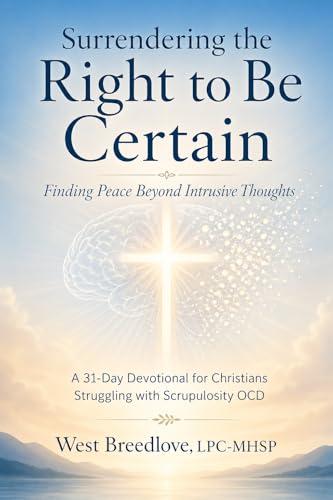
My book · 31-day devotional
Surrendering the Right to Be Certain
A devotional for Christians struggling with scrupulosity OCD.
View on Amazon (opens in a new tab)Your faith deserves thoughtful care. Your OCD deserves specialized treatment.

West Breedlove, LPC-MHSP
- LPC-MHSP
- NCC
- ERP & I-CBT
I provide specialized treatment for OCD, including intrusive thoughts, mental compulsions, scrupulosity, and other OCD presentations.
We’ll pinpoint the specific patterns that keep your OCD going and use targeted strategies, including ERP and I-CBT, to change them. The work is collaborative, practical, and built around you, not a symptom checklist.
More on OCD and how it’s treated.
Article
Why You Can’t Stop Intrusive Thoughts (And What Actually Helps)
Why fighting your thoughts backfires, and what helps instead.
Read the articleArticle
Reckoning With OCD: The Truth About ERP Therapy
What ERP actually involves, and why it works.
Read the articleArticle
What Is I-CBT for OCD? Inference-Based CBT Explained
How I-CBT untangles the reasoning behind obsessive doubt.
Read the articleGuide
What Is OCD? Symptoms, Causes & Treatment
The obsession–compulsion cycle, and how it’s treated.
Read the guideGuide
Harm OCD: When the Thoughts You Fear Most Won’t Go Away
Why violent intrusive thoughts don’t mean you’re dangerous.
Read the guideGuide
Religious OCD (Scrupulosity)
When fear of sin and doubt about salvation become OCD.
Read the guideQuestions about OCD counseling
Can OCD improve if the intrusive thoughts don’t go away?
Yes. Effective treatment focuses on reducing compulsions and distress, improving daily life, and changing how you respond to intrusive thoughts, rather than trying to control every thought.
What’s the difference between ERP and I-CBT?
ERP focuses on approaching triggers while reducing compulsions. I-CBT focuses on the reasoning that makes obsessive doubts seem believable. Your plan depends on your clinical needs, and many clients benefit from both.
Can therapy help with “Pure O”?
Yes. What’s often called Pure O usually involves mental compulsions such as reviewing, checking feelings, neutralizing thoughts, or seeking reassurance. These patterns respond well to OCD-specific treatment.
Do you offer online OCD therapy?
Yes. Telehealth is available for clients located in Tennessee and Florida. In-person sessions are in Chattanooga.
Do you accept insurance?
Reconciled Hope is a private-pay, out-of-network practice. A superbill is available on request; reimbursement depends on your plan. See rates.
You don’t need certainty to take the next step.
If OCD has been eating up your time, confidence, or relationships, specialized treatment can help you start responding differently.
Reconciled Hope Counseling, LLC · 243 Signal Mountain Rd, Suite 131 · Chattanooga, TN 37405 (opens in a new tab) · 423-930-9030